
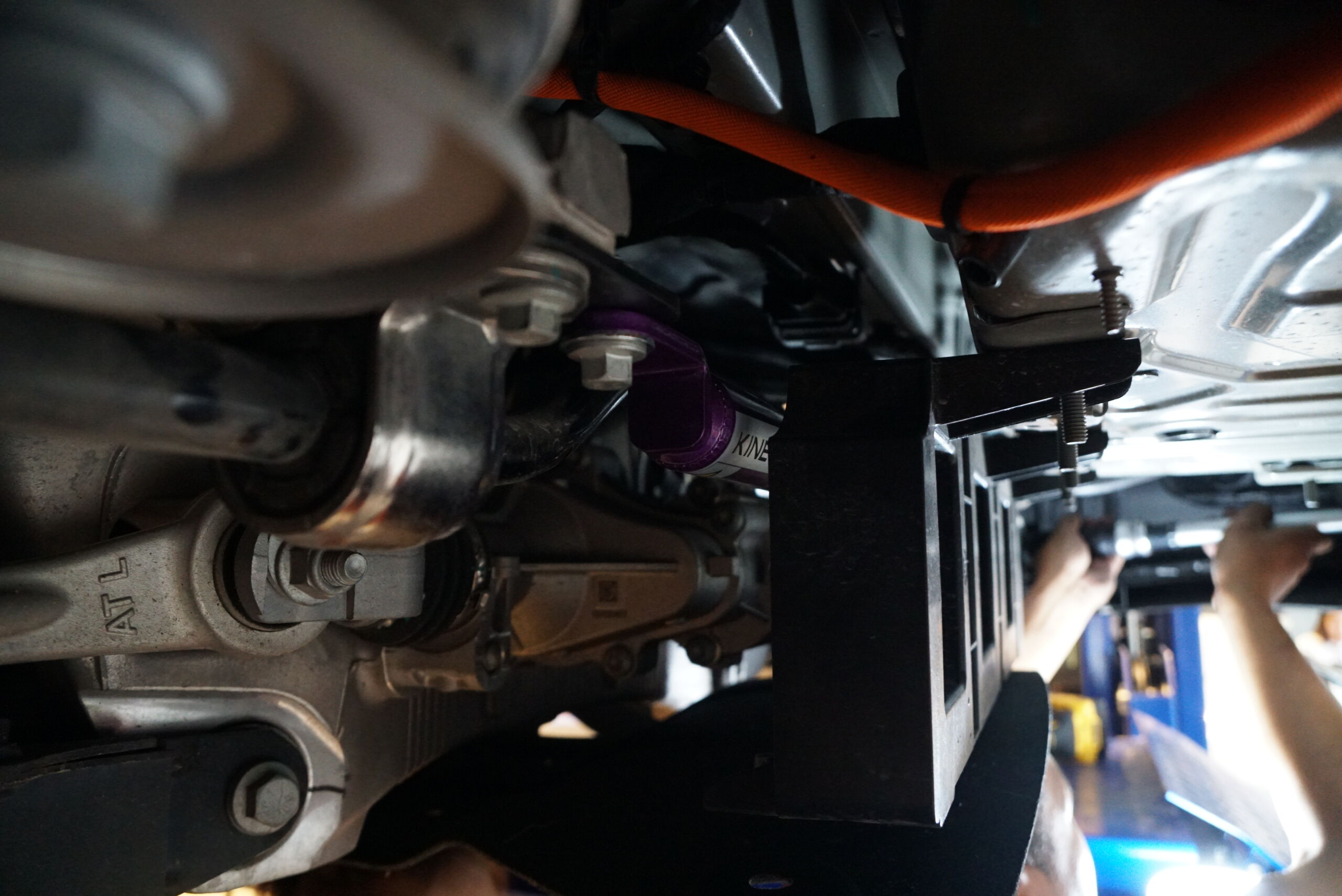
The KINETIQ Motion Damper is installed between structural points of the vehicle’s chassis — not as a load-bearing suspension component, but as a device that absorbs vibration and secondary oscillation the suspension was never designed to fully control. That distinction is exactly why how it’s installed matters as much as the part itself.
Why Ride Height Matters For A Structural Damper
A conventional two-post lift raises a vehicle by its frame or pinch points, leaving the wheels hanging free. That’s fine for most service work. But it changes the vehicle’s suspension geometry from what it is at normal ride height — and if a structural damper is torqued into place while the suspension is hanging in that unloaded position, it can be preloaded before the car has ever been driven.
What Happens When It's Installed Wrong
A preloaded damper doesn’t necessarily fail outright. It’s more likely to simply underperform — absorbing less of the vibration and oscillation it was engineered to manage, in a way that’s difficult to diagnose after the fact because nothing is visibly broken. The car just doesn’t feel as composed as the engineering promised, and there’s no obvious reason why.
Proper installation requires the suspension to remain at normal ride height. This is not a preference — it's a specification.
The KINETIQ Standard
For this reason, KINETIQ specifies installation using lifts that support the wheels at ride height — a four-post lift, a drive-on lift, or the vehicle resting on its wheels on ramps — rather than a conventional two-post frame lift with the suspension hanging free.
What To Ask Your Installer
- Confirm the lift type supports the wheels, not just the frame, during installation
- Confirm mounting hardware is torqued to specification at ride height, not before
- Confirm the installer has been trained on the Ride Height Installation Standard™ specifically
This is a short checklist, but it’s the difference between a Motion Damper that performs as engineered and one that quietly doesn’t.
