
-
AVATR 11
Soft...
But Not Yet Settled.Softness brings comfort, but excess motion can still leave the car feeling bouncy, tossy, and not as settled as it should be.
LESS BOUNCE · LESS FLOAT · MORE COMPOSED
-
ZEEKR 7X
Powerful And Comfortable.
But Motion Still Follows.Manage excess body roll and motion, so the car feels settled, unified, and more confident.
BETTER BODY CONTROL · MORE COMPOSED · MORE CONFIDENT
-
MG IM5
Already Good.
Still Room To Refine.Manage the finer details of motion and vibration, for more settled composure, refinement, and a more natural response.
LESS VIBRATION · REFINED ROAD RESPONSE · MORE CONNECTED
Refine What You Feel. Not Just How The Car Performs.
The Motion Damper isn’t meant to make the car stiffer or softer. It manages the excess motion and vibration in the chassis and body — so the way the car moves feels calmer, more unified, and more refined.
The Hidden Motion Problem
Quieter Cabins Make Motion More Noticeable, Not Less.
Modern vehicles — especially EVs — are becoming heavier, more powerful, and quieter. Ironically, the quieter the cabin becomes, the more passengers notice unwanted motion: small body oscillations, secondary bounce, and road vibration that used to be masked by engine and road noise.
Driver Fatigue
Continuous small corrections and vibration accumulate over a long drive.
Passenger Discomfort
Rear passengers feel secondary bounce and head toss more than the driver does.
Reduced Premium Feel
A vehicle can be quiet and powerful, yet still feel unsettled over rough roads.
This is exactly what the Motion Damper is engineered to address — not by changing springs or shock absorbers, but by adding targeted structural damping between chassis points, so this excess motion settles faster.
How It Works
Hydraulic Circuit And Nitrogen Chamber, Working Together.
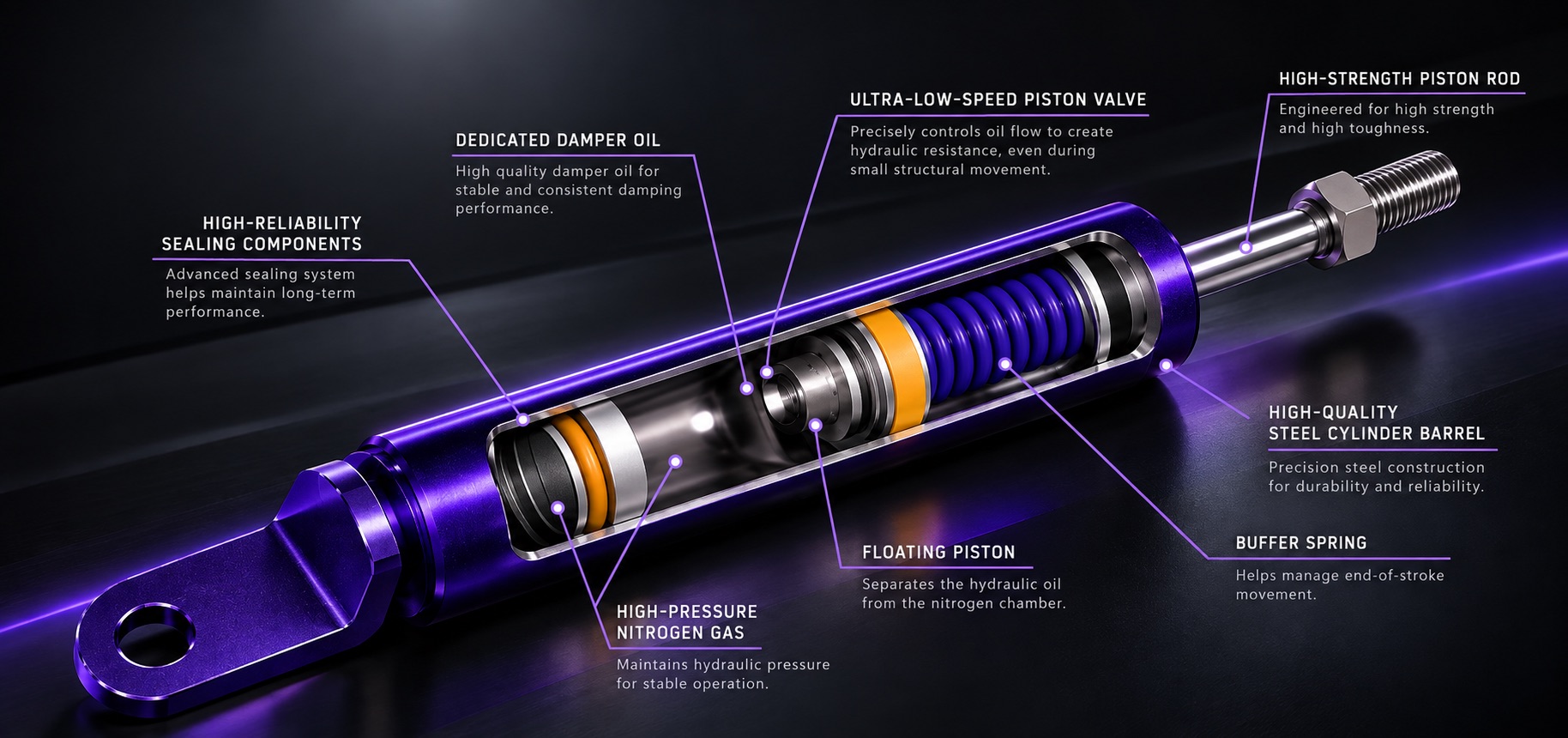
The Motion Damper is installed between structural points of the chassis — not a load-bearing part. As the structure moves, hydraulic fluid inside is forced through precisely engineered valving, generating resistance that varies with the speed of that movement. A sealed nitrogen gas chamber inside absorbs the resulting change in fluid volume from pressure and heat, and maintains a consistent return force — so damping performance stays the same whether you’ve been driving for five minutes or five hours, or under Thailand’s heat.
Hydraulic Circuit
Generates resistance that scales with the speed of structural movement, not a fixed force.
Nitrogen Chamber
Keeps pressure and damping force consistent, even as fluid expands under heat or repeated cycling.
What You Feel
6 Things That Change When Motion Is Managed Correctly.
01
LESS BOUNCE. LESS FLOAT.
Less bounce, toss, and lingering motion after the car crosses a bump or a change in road surface.
The Motion Damper dampens excess structural movement, so secondary motion settles faster.
02
MORE COMPOSED.
During lane changes, cornering, or any shift in the forces acting on the car, the body feels tighter and more composed.
A damper mounted at the right point manages relative motion between chassis and body points, reducing the excess movement that follows a change in direction.
03
REFINED ROAD RESPONSE.
Less harshness and vibration following a road seam or expansion joint, so impacts feel cleaner and end sooner.
The Motion Damper doesn't remove the initial impact the wheel absorbs — it manages the structural vibration and secondary response that follow it into the car.
04
LESS VIBRATION.
Reduces some of the fine vibration that travels through chassis and body into the cabin experience.
As the structure moves between mounting points, the Motion Damper generates a damping force that helps dissipate the energy of that movement.
05
MORE CONNECTED. MORE CONFIDENT.
As excess structural motion and vibration are reduced, the car’s response and the feel through the steering wheel can feel cleaner, tighter, and more unified.
Adding structural damping at the right point reduces some of the movement and vibration that interferes with the feedback a driver perceives — without changing steering ratio or EPS calibration.
06
CALMER PASSENGER EXPERIENCE.
Especially in the rear seats, reducing excess body motion can help the movement transmitted through the floor and seats feel calmer and more consistent.
The Motion Damper doesn't act on passengers directly — but when the body motion that feeds into the system is reduced, the motion that reaches the seat and the passenger tends to reduce with it.
Engineering Standard
Ride Height Installation Standard™
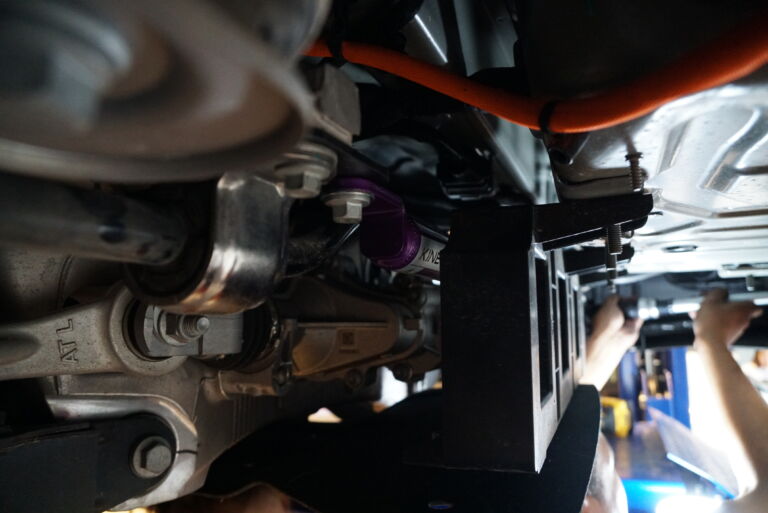
Proper installation requires the suspension to remain at normal ride height. Installing while the suspension hangs on a conventional two-post lift can preload the damper and reduce its intended performance — which is why KINETIQ specifies installation using lifts that support the wheels at ride height.
Vehicle-Specific Engineering
Not A Universal Accessory.
Each Motion Damper is developed directly with the vehicle’s own engineering team — not adapted from a generic part. Because vehicle dynamics differ significantly between models, KINETIQ’s engineers test and tune mounting position, working direction, and damping rate on real Thai roads, under the driving conditions, climate, and road surfaces Thai drivers actually face every day — not lab results or an overseas test track alone.
Material Quality
Built To Automotive Standards.
Structure
High-strength carbon steel
Components
Precision machined
Mechanism
Nitrogen-hydraulic damping
Manufacturing
Automotive quality systems
Looks The Same. Isn't.
From the outside, the KINETIQ Motion Damper can look like any other damping device. What’s inside is technology refined continuously for over 20 years. The result is performance that holds up in everyday use, backed by quality and durability we’re confident enough in to offer a 3-year warranty when you register online.
One System. Different Refinement.
What matters is that the Motion Damper doesn’t work the same way in every position. Every vehicle has its own motion character, so mounting position, working direction, and damping character all have to be chosen to match the vehicle and the behavior being refined.
Not about minimizing how much the car moves. About better managing the motion that doesn't need to be there.
THE RIGHT MOTION.
BETTER CONTROLLED.
KINETIQ Motion Refinement System™
Designed For
Refinement, Not Stiffness.
Battery Electric Vehicles
Luxury SUVs
Premium Sedans
Performance Daily Drivers
Knowledge Center
Go Deeper On The Engineering.
FAQ
Common Questions.
01 Will this make my suspension feel stiffer?
No. The Motion Damper is not a suspension upgrade and does not increase stiffness. It absorbs vibration and secondary oscillation between structural points, helping the vehicle settle faster without changing spring or damper rates.
02 Does it work on electric vehicles?
Yes — EVs are a primary use case. Their added weight, power, and quietness make unwanted motion more noticeable, which is exactly what Motion Refinement is engineered to address.
03 How is this different from a sway bar or performance damper?
Sway bars and performance dampers are tuned to reduce body roll during cornering at speed. Motion Refinement is tuned for composure across an entire journey — including the low-speed, everyday driving where most passengers spend most of their time.
04 Can this help with motion sickness?
Unwanted vehicle motion is one of several factors that may contribute to discomfort for motion-sensitive passengers. Motion Refinement is engineered to reduce that motion — it is not marketed or intended as a treatment or prevention for motion sickness.
05 What does the 3-year warranty cover?
Once you register your product online after installation, the Motion Damper is covered for 3 years, including the hardware and its damping mechanism. Your installer will walk you through the registration steps and terms during installation.
Get Started
Ready For A Calmer Ride?
Talk to a specialist about Motion Damper fitment for your vehicle, engineered and tuned per platform.